

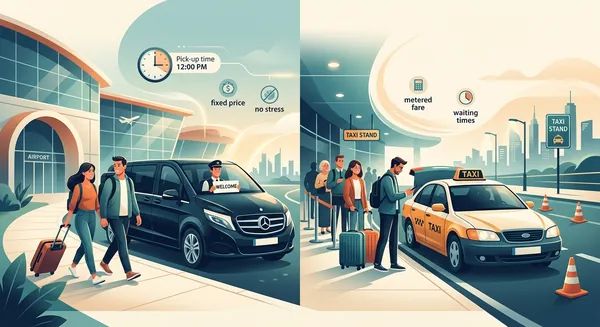
When you land after a long flight, the last thing most people want is a pricing puzzle in the arrivals hall. In practice, the choice usually comes down to two familiar options: a pre-booked airport transfer or a regular taxi. Both will get you to a hotel, apartment, office, or cruise port, but the better value is not always the one with the lowest advertised fare.
Real value is a mix of price, predictability, comfort, time saved, and the chance of things going wrong. A taxi may appear cheaper at first glance, especially if the ride is short. A transfer may cost a little more, but often includes a fixed fare, flight monitoring, and a clearer pickup process. If you want to spend wisely rather than simply spend less, it helps to compare the full trip, not just the first number you see.
In this guide, we’ll compare airport transfers and taxis in practical terms, explain when each one makes sense, and show you what to check before you book.
Airport Transfers vs Taxis: What’s the Difference?
An airport transfer is usually booked before you travel. A driver meets you at the airport or at a defined pickup point and takes you directly to your destination for an agreed price. Many transfer companies also offer useful extras such as flight tracking, a meet-and-greet sign, a short free waiting period after landing, luggage help, and the option to choose a vehicle size in advance. Typical categories include standard sedan, executive car, people carrier, and minibus.
A taxi is normally hired on arrival from an airport rank, by phone, or through a local ride-hailing app if that service operates legally at the airport. Pricing varies by destination. Some airports use metered fares, some add airport supplements, and some cities use fixed-rate zones to central districts. Depending on the local rules, the total may also include tolls, waiting time, late-night surcharges, or baggage fees.
On the surface, both do the same job. In practice, they feel very different. A transfer is usually more structured. A taxi is usually more flexible.
Why the Choice Matters
Price Is Only One Part of Value
Many travelers compare only the base fare. That misses the details that often decide whether a ride feels like a good buy. Airport transport can involve queue time, surge pricing on apps, card fees, extra airport charges, or a more expensive route if traffic is bad. Those costs do not always show up until the end of the ride.
For example, a metered taxi can get expensive in slow traffic because time is part of the fare in many cities. A transfer with a fixed price shields you from that. On the other hand, if your hotel is close to the terminal and the airport has a well-run official taxi system with posted rates, booking a private transfer can be more service than you need.
Arrival Conditions Affect the Best Choice
Your own trip matters just as much as the local pricing system. Families with child seats to think about, older relatives, first-time visitors, people arriving after midnight, business travelers on a schedule, and anyone with several bags usually put a high value on certainty. A solo traveler with one carry-on may care more about paying the lowest possible fare.
Think through the arrival honestly:
- Will you land late at night or very early in the morning?
- Are you traveling with children, elderly companions, or anyone who tires easily?
- Do you know the local language well enough to handle directions and disputes?
- Do you need a larger vehicle for skis, golf clubs, surfboards, a stroller, or several large suitcases?
- Is the airport known for long taxi queues, unofficial drivers, or confusing pickup rules?
The more complicated the arrival, the more a pre-booked transfer tends to justify its cost.
When Airport Transfers Offer Better Value
1. You Want a Fixed Price
This is the biggest reason people book transfers. You know the fare before you leave home, so budgeting is straightforward. That matters in destinations where toll roads are common, where traffic can be heavy for long stretches, or where you do not know the normal taxi rate from the airport. Fixed-price booking is also useful for groups splitting the cost, because everyone knows their share in advance.
It is still worth checking what “fixed” includes. Some providers bundle airport parking, tolls, and a set amount of waiting time into the quote. Others add certain fees later or have separate charges for child seats or extra stops.
2. You Need Reliability After a Flight
Flights are delayed. Baggage can take a long time. Immigration lines can be slow. Good transfer services usually monitor your flight number and adjust pickup time if you land late. That can remove a lot of stress, especially on long-haul trips. In many cases, the driver will wait for a defined period after landing or after the scheduled pickup time. The exact allowance varies, so it is smart to read the policy rather than assume unlimited waiting.
The catch is that transfers are less forgiving if your plans change completely. If you miss your flight, change terminals unexpectedly, or decide to stop for food before pickup, you may need to contact support quickly to avoid a no-show fee.
3. You Value Time and Convenience
At busy airports, the time difference can be real. A pre-booked driver may meet you inside arrivals or direct you to a nearby pickup zone, which can be faster than joining a long taxi rank. This matters most in summer, during holiday weekends, after large conferences, or when several flights land at once. After a red-eye, avoiding a 30-minute queue can feel worth the extra cost on its own.
4. You Need the Right Vehicle
Vehicle choice is one of the most practical reasons to pre-book. Standard airport taxis are not always ideal for four adults with large cases, a folded stroller, or sports gear. With a transfer, you can usually reserve the class you need: a sedan for one or two travelers, an MPV for a family, or a minibus for a group. That reduces the risk of standing at the rank while the dispatcher looks for a bigger car.
It also helps with special requests. If you need an infant seat, extra luggage space, or a wheelchair-accessible vehicle, arranging it in advance is often easier than hoping one is available on the spot.
5. You Prefer a More Predictable Experience
For a lot of travelers, predictability is the whole point. You know the company name, the pickup instructions, the vehicle type, and the approximate route before landing. That is especially helpful in a large airport where arrivals halls can be chaotic and many drivers are holding signs. A clear transfer confirmation with driver contact details is not glamorous, but it removes guesswork.
When Taxis Can Be Better Value
1. Your Trip Is Short and Simple
If your hotel is close to the airport, a taxi is often the sensible choice. Paying for a pre-booked car can feel unnecessary if the ride is quick and there is an official rank just outside the terminal. This is even more true in cities that publish flat airport fares to central zones, hotels, or train stations. Where those systems are enforced well, the taxi can offer nearly the same certainty as a transfer at a lower cost.
2. You Need Maximum Flexibility
Taxis work well if your plans are loose. Maybe you are not sure how long immigration will take. Maybe you are meeting someone first and deciding the destination later. Maybe your accommodation could change on the day. A taxi gives you the freedom to walk out and go when you are ready, without editing a booking or talking to customer support.
That flexibility can come with a trade-off, though. In some airports, the queue is short and easy. In others, it can be long, poorly managed, or confusing if ride-hailing pickups use a separate lot.
3. The Local Taxi System Is Well Regulated
Taxis are strongest where the rules are clear and actually enforced. Good signs include licensed cabs only, posted fares or visible meters, airport staff managing the line, official receipts, and easy card payment. If the airport website itself explains the fare structure in plain terms, that is usually a good sign for travelers.
Where those safeguards are weak, taxis can still work out fine, but the margin for hassle is higher. That is where a transfer often earns its keep.
4. You Are Traveling Light and Alone
A solo traveler with one backpack or a cabin suitcase often needs less hand-holding. If you are comfortable navigating arrivals, know how local taxis work, and are not carrying much, a taxi can be the cheapest simple option. You are also easier to fit into the next available car, which matters when larger vehicles are in short supply.
Practical Tips to Compare Real Value
Before choosing, compare the whole journey rather than only the first fare you see.
- Check all extra charges: Look for tolls, airport pickup fees, waiting charges, late-night surcharges, child-seat fees, and card payment fees.
- Estimate traffic impact: If taxis are metered, slow roads can increase the total noticeably.
- Consider wait time: A cheaper ride loses value fast if you stand in line for a long time after landing.
- Think about cancellation terms: Some transfer bookings allow free cancellation up to a set number of hours before pickup, while others are stricter.
- Read recent reviews: Focus on driver communication, pickup clarity, punctuality, and how problems were handled.
- Confirm pickup instructions: Good transfer services tell you exactly where to meet the driver and what to do if you cannot find them.
- Check luggage allowances: A “3-passenger” car may not hold 3 large checked bags comfortably.
- Verify payment method: Not every taxi takes foreign cards reliably, and not every transfer lets you pay the driver.
A simple rule works well: if a transfer costs a little more but removes uncertainty, queueing, or surprise fees, it may still be the better buy.
What to Look for When Buying an Airport Transfer
Transparent Pricing
Choose a service that spells out what the fare includes. You want to know if taxes, tolls, parking, airport access fees, and waiting time are part of the quoted price. If the service is vague, compare carefully before booking.
Flight Monitoring
This is one of the most useful features for airport pickups. Entering your flight number allows the company to track delays and adjust the pickup. Without that, you may need to call the operator if your landing time changes.
Meet-and-Greet Support
For first-time visitors or arrivals in very large terminals, a named driver or a clearly marked meeting point is a real help. It is not essential for every traveler, but it is valuable if you are tired, managing children, or arriving somewhere unfamiliar.
Vehicle Choice
Look for clear vehicle categories and passenger or luggage guidance. “Standard,” “business,” and “van” mean different things across providers, so check the fine print. Photos help, but the luggage allowance matters more.
Strong Reviews and Customer Support
Reliable support matters if your flight changes or the pickup point is crowded. Recent reviews can tell you whether the company answers messages quickly and whether drivers are easy to identify. A cheap booking is less appealing if the support line is hard to reach when something goes wrong.
Easy Booking and Clear Communication
The confirmation should include the booking reference, pickup instructions, contact details, and local guidance if needed. If that information is scattered across several emails or missing entirely, the arrival may be less smooth than promised.
So, Which Is Better Value?
There is no universal winner. Taxis often offer better value for short, straightforward rides in cities with reliable airport cab systems and transparent fares. Airport transfers usually offer better value if you want a fixed price, dependable pickup, a specific vehicle size, or a calmer arrival after a long trip.
For many travelers, especially in an unfamiliar destination, the smartest choice is not the cheapest ride on paper. It is the one that protects your time, lowers the chance of hassle, and fits the way you travel. Paying a bit more upfront can make sense if it saves you a long queue, a difficult negotiation, or an avoidable surprise at the end of the journey.
If you are comparing options now, use the airport website, recent traveler reviews, and the exact fare terms to make the call. That extra five minutes of checking usually tells you more than a headline price ever will.
Our Top Recommendations
Based on this guide, here are hand-picked products from our partners that we recommend:


We may earn a commission if you buy through these links, at no extra cost to you.